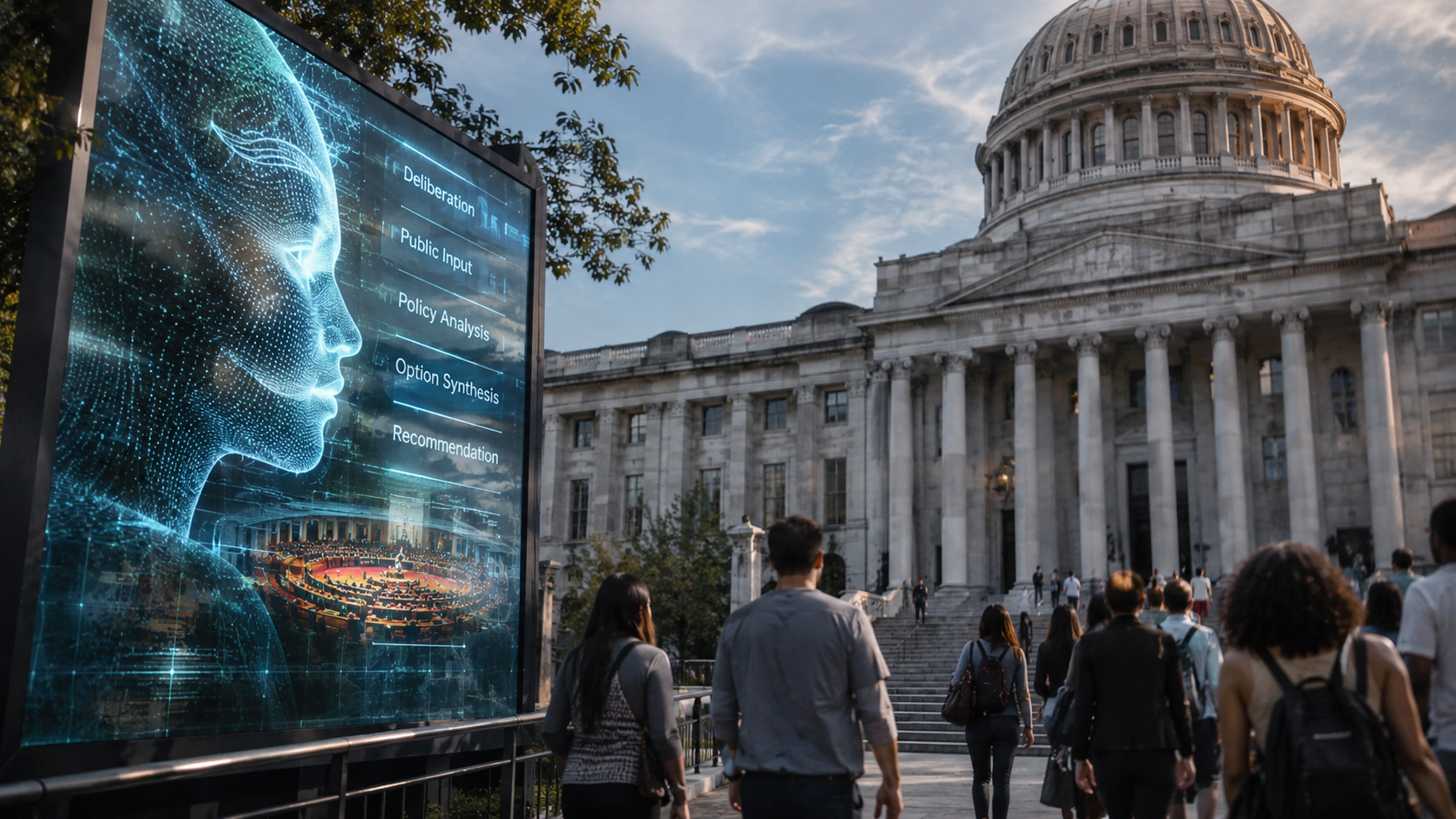
What if AI could improve democratic decision-making while simultaneously undermining democracy itself?
In this episode of the AITEC Philosophy Podcast, Roberto and Sam speak with philosopher Lorenzo Manuali about his paper, “When LLMs Threaten Democratic Autonomy.” The conversation begins with a provocative thought experiment: imagine an AI that governs society better than humans ever could. Would something still be lost if we were no longer genuinely governing ourselves?
Manuali argues that this problem is no longer merely hypothetical. Large language models are already being explored as tools for democratic participation. Facilitative LLMs can moderate deliberation, summarize discussions, and help groups reach decisions, while representative LLMs can attempt to predict what citizens would prefer—even about policies they have never considered.
But these possibilities raise difficult questions. Could AI moderation flatten minority perspectives? Is an AI-generated prediction of what you would want equivalent to actually forming that political intention yourself? And when comparing AI with human moderators—who are themselves vulnerable to conformity, groupthink, and bias—what should the appropriate standard be?
The conversation explores perspectival homogenization, persistent minorities, joint intention, collective self-determination, and the difference between better political outcomes and genuine democratic authorship. At stake is a fundamental question about democracy in the age of AI: Is it enough for our political institutions to make good decisions, or must those decisions genuinely be ours?